IIA Netherlands publishes Practice Guide on Insight and Foresight
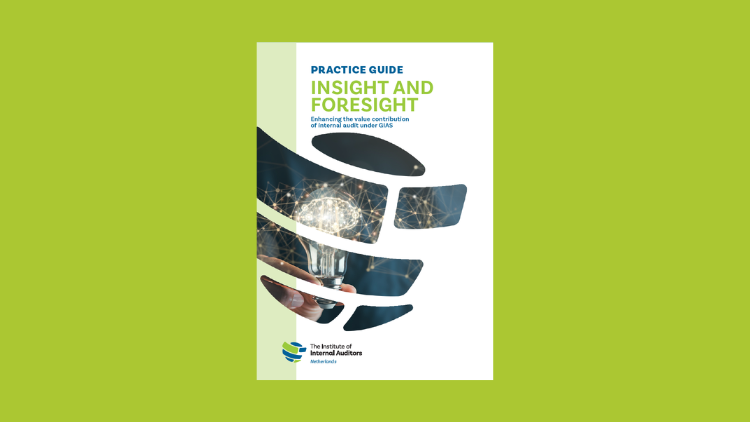
IIA Netherlands has published a new Practice Guide, Insight and Foresight, offering internal audit functions practical guidance on delivering two outcomes that have moved to the centre of the profession's value proposition.
The Purpose Statement of the Global Internal Audit Standards (GIAS) describes internal auditing as strengthening the organisation's ability to create, protect, and sustain value by providing independent, risk-based, and objective assurance, advice, insight, and foresight. Yet while assurance and advisory services are well defined in the Standards, insight and foresight are not.
With this Practice Guide, IIA Netherlands aims to support internal audit functions in giving these outcomes further substance by clarifying what they entail, how they relate to existing services, and how to deliver them in conformance with the GIAS.
Insight and Foresight as Internal Audit Outcomes
Drawing on professional literature, interviews with experienced practitioners, and a survey conducted by IIA Netherlands, the guide positions insight and foresight as outcomes of internal audit activities, whether delivered through regular assurance and advisory engagements or organised as dedicated work within the audit plan intended to support the board and senior management.
Insight moves the function beyond reporting what is happening towards explaining why: for example, from individual observations to root causes, from isolated findings to systemic themes, and from data to meaningful, audience-relevant interpretation.
Foresight enables internal audit to anticipate emerging and future risks rather than merely describing the current risk profile, using methods such as trend analysis, horizon scanning, scenario building, and early warning indicators.
Competences and Practical Challenges
Beyond methods and examples, the guide also addresses what delivery requires in practice.
Survey respondents identified competences that are not yet fully embedded in internal audit training and development, including business expertise, systems and strategic thinking, scenario thinking, advisory skills, and knowledge of AI. They also pointed to the challenge of generating sufficient evidence to support forward-looking conclusions.
The guide emphasises that insight and foresight remain internal audit outcomes and must therefore conform with the Standards. The same requirements for evidence, objectivity, and quality apply.
Recommendations for CAEs and Auditors
The closing chapter offers strategic recommendations for Chief Audit Executives, including embedding insight and foresight in the function's regular service portfolio, defining the applicable quality assurance requirements, strengthening competences, leveraging existing audit data through AI-enabled analysis, and stimulating demand from the board and senior management through sustained, substantive dialogue.
These are complemented by operational recommendations for individual auditors, ranging from asking better questions and changing perspective to identifying trends and improving the way messages are communicated.
Growing Importance for Internal Audit
The Practice Guide concludes that insight is increasingly embedded in internal audit practice, while foresight is still emerging but gaining traction. Both warrant deliberate investment.
Internal audit functions are encouraged to use this Practice Guide as a basis for discussion with their teams, the board, and senior management about ambitions, needs, and practical possibilities, strengthening performance and added value without compromising independence, objectivity, or quality.